
The 2015 South African wine grape harvest shows great promise and domestic wine sales are the highest in 20 years. However, exports and profitability of wine producers and cellars remain challenging.
This according to Rico Basson, MD of VinPro, the representative organisation of close to 3 500 South African wine producers and cellars. He spoke at a wine and fruit industry update, presented by the Minister of Economic Opportunities in the Western Cape, Alan Winde, yesterday at De Grendel Wine Estate near Cape Town.
The current harvest year marks the third season in a row in which the South African wine industry realised a large wine grape crop. Although it will be slightly smaller (close to 3%) than the record harvest in 2014, winemakers and viticulturists laud the 2015 harvest as one of remarkable quality throughout the cultivar spectrum.
It is expected that the total wine grape harvest will have reached cellars by the end of March. The harvest kicked off two weeks earlier than normal, partly due to a warmer August, followed by a very dry and hot summer which sped up ripening.
The South African wine industry on average harvests close to 1.5 million tons of wine grapes, of which an estimated 900 million litres of natural wine is produced. Exports represent 55% of natural wine sales, with 45% sold locally.
At the end of 2014, local wine sales volume was at the highest level in 20 years, the 353 million litres natural wine sales representing 7.3% growth from 2013. This growth was largely driven by bag-in-box packaging (17.4%), which represents close to 29% of total local sales. Wine sales in 750 ml glass bottles, which represent 30% of the local market, grew by 11%.
“We are excited about the good growth in local wine sales. Some of the factors that contributed to this, include a strong focus on wine tourism in the Western Cape, marketing alignment in the past few years, as well as a growing middle class trading up to branded goods,” said Basson.
The export market remains challenging, with EU countries being South Africa’s main export market. “The recessionary slump and surplus product in certain categories still has an effect on sales in these countries; however we are seeing stable growth in the UK,” Basson added.
Wine exports to China have risen sharply from 5.7 million litres in 2013 to just more than 8.7 million litres at the end of 2014 – the majority being packaged wine. Africa is also a key focus area for wine export growth, with an increase in infrastructure investment aiding access.
Basson said that the high quality of this year’s harvest strengthens the wine industry’s drive towards promoting premium packaged wines. The ratio of wine in bulk versus packaged is currently at 60:40, with a part of bulk exports being bottled overseas. “Key players in the industry are busy with a strategic initiative, through incentives from an Economic Partnership Agreement with the EU, to bring bottling back to South Africa. This will add economic value and promote job creation,” said Basson.
“The growth in domestic sales and promising wine harvest are definitely worth celebrating. However, the industry and its producers and cellars still face some key challenges to profitability,” cautioned Basson.
He added that the South African wine industry was busy with a Wine Industry Strategic Exercise (Wise), which would result in strategic initiatives to address these challenges and close gaps in the value-chain. “A multi-stakeholder approach, including close partnering with Government, will be crucial in achieving success,” he said.
Emphasising the importance of ethical trade in the wine industry, Basson said that 60% of all Fairtrade accredited wine sold in the world is from South Africa. Wieta (Agricultural Ethical Trade Initiative of SA) now stands at close to 1 300 wine producer and cellar members, with a strong growth in accreditation volumes to the current close to 26% of the total wine grape harvest (around 400 000 tons) being ethically accredited. “Through these and other ethical trade accreditations, the wine industry is making sure working conditions adhere to, and exceed those stipulated in labour legislation,” he added.
Basson thanked Minister Winde for the Western Cape Department of Agriculture’s commitment of R1 million to Wieta for ethical trade initiatives, the second year in a row.
For enquiries, contact Jana Loots, 021 276 0429, jana@vinpro.co.za.
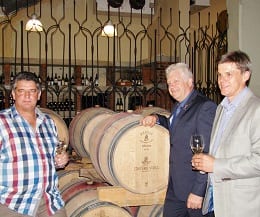
During the harvest media briefing: De Grendel cellarmaster Charles Hopkins with Min Alan Winde and Rico Basson of VinPro.
